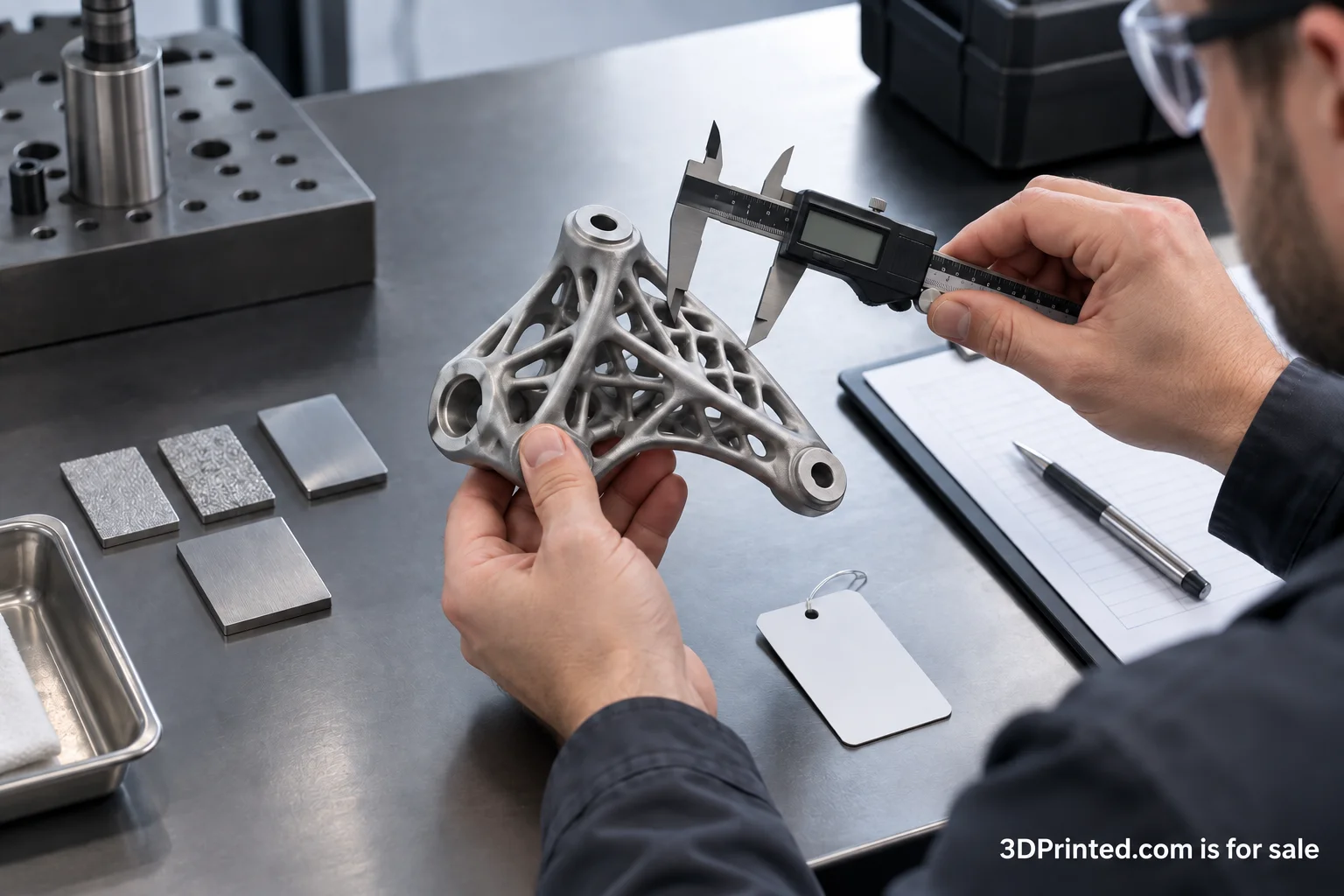
A part can finish printing, look clean, and fit its mating geometry without being ready for production. Production readiness is a release decision based on intended use and evidence. It asks whether the team can make the right part, finish it, verify it, trace it, and repeat that work under defined controls. The printed shape is one result inside that larger system.
This distinction prevents a common planning error: treating machine completion as part completion. A build may still require support removal, feedstock removal, cleaning, treatment, machining, surface work, assembly, inspection, or testing. Some projects need only a small subset of those steps. Define the finished state before anyone quotes, schedules, or releases the work.
Start with the intended use
Production-ready has no useful meaning without a job. A display model, a drill guide, a replacement cover, and a load-bearing component do not share one acceptance plan. Begin by documenting the function, users, operating environment, interfaces, expected service, quantity, and consequences of failure. The responsible team can then identify the requirements and qualified reviewers that fit the risk.
This first gate also keeps prototypes in their proper role. A prototype can answer a valuable question about appearance, assembly, access, or geometry. Passing that check does not automatically establish production material behavior, process repeatability, or finished-part conformity. If the project advances, the team should state which prototype findings carry forward and which production questions remain open.
The America Makes Additive Manufacturing Adoption Playbook connects additive adoption with process families, materials, design, business case, readiness, and qualification. That framing is helpful because readiness is both technical and operational. A capable machine cannot repair an incomplete requirement, unclear ownership, or an inspection method chosen after the parts arrive.
Define the delivered part
A purchase description should identify what the delivered item includes. Does the supplier deliver a part on the build plate, a support-free blank, a machined component, a cleaned assembly, or an inspected and documented finished part? Ambiguity here creates later arguments about lead time, cost, and acceptance.
Create a part requirement record with at least these fields:
- approved geometry and revision
- intended function and service environment
- critical interfaces and dimensions
- selected process family and material specification, or the owner of that selection
- orientation or build constraints when they affect the requirement
- required post-processing and protected features
- inspection and test criteria
- documentation and traceability needs
- packaging, storage, and handling needs where relevant
- named authority for deviation approval and final release
Not every field needs a long specification. An explicit not applicable is more useful than silence because it shows the item was considered. Unknowns should have owners and due dates before production release.
Control the digital thread
The physical part begins with controlled digital information. The team needs a way to know which design revision was approved, which file entered build preparation, what transformations occurred, and which prepared build was released to equipment. File names alone are weak change control when copies can circulate across email, shared drives, and supplier portals.
A practical record can connect the approved design identifier to the build-preparation software, relevant settings, orientation, support strategy, machine assignment, and build record. The level of detail should match the application and governing requirements. If a result is questioned later, the team can identify what it intended to make and what production input was actually used.
Change review belongs here too. A geometry edit, software update, material change, alternate machine, revised orientation, or post-processing change may affect different evidence. Do not assume that a change is harmless or that it invalidates everything. Route it through a defined review that decides what must be repeated, updated, or accepted.
Match material and process to the requirement
3D printed does not identify one material condition or one manufacturing route. Additive manufacturing includes multiple process families, and each process-material combination brings its own preparation, control, finishing, and verification questions. Selection should follow the part requirement rather than the appeal of a machine demonstration.
Ask a provider to state the proposed process family, material specification, relevant feedstock controls, machine and build controls, and the finished condition being quoted. The answer should be specific enough for the responsible technical team to evaluate. A familiar material family name or an industry logo on a capabilities page is not a part-specific acceptance record.
NIST's measurement science program for additive manufacturing identifies process variability, accuracy, surface quality, material consistency, monitoring, inspection, and qualification as substantive concerns. Those topics explain why production readiness cannot be judged from geometry alone. They also point toward the evidence questions a team should allocate before ordering a run.
Plan post-processing at the beginning
Post-processing is part of the route, not a cleanup note added after fabrication. It can affect schedule, access to features, measured dimensions, surface condition, and the definition of the finished material state. The plan should say which party performs each step, in what sequence, under what instruction, and with what acceptance check.
The FDA's example process for 3D-printed medical devices lays out design, software preparation, material controls, printing, post-processing, verification, and testing as a connected flow. This is not a general recipe for medical approval or a shortcut for other industries. It is a useful public example of why downstream steps must be considered as part of manufacturing.
For an ordinary industrial part, the checklist may be modest: remove supports according to the defined method, finish a specified interface, clean the part, and inspect named features. For another part, the route may demand specialized controls and qualified review. The requirement, not the excitement around the process, determines the depth.
Decide how conformance will be shown
Inspection begins with a question, not an instrument. Which characteristics show that the finished part meets its requirements? Who measures them? At what stage? What method is suitable for the geometry and expected result? What record will accompany the part or remain available for review?
Separate three ideas that are easy to blur:
- Verification asks whether the output meets defined requirements.
- Functional testing checks behavior under the conditions specified by the responsible team.
- Process evidence shows how the part was made and whether required controls were followed.
A project may need evidence from all three groups, but one record does not automatically substitute for another. A dimensional report does not by itself establish material condition. A material certificate does not prove every finished dimension. A successful function check does not identify which digital revision was built. Build an acceptance package around the actual claims the team needs to make.
NIST's research focus on monitoring, measurement, and qualification also cautions against a photograph-based release. Appearance can reveal obvious issues, and visual inspection may be a defined check, but an attractive surface is not evidence for every hidden or quantitative requirement. Use the methods specified by the responsible engineering and quality functions.
Check repeatability before calling the route established
One acceptable part demonstrates one result. Production planning asks whether the organization can repeat the defined route and recognize departures from it. That means identifying the controlled inputs, the records retained for each build or lot, the checks performed, and the response when a result falls outside a limit.
Repeatability does not require pretending that every output is identical. It requires an agreed way to manage variation against requirements. The team should know which changes need review, how nonconforming parts are contained, who approves deviations, and when evidence must be refreshed. The applicable quality system or customer requirement may prescribe additional controls.
Supplier capability belongs in this review, but a broad capability statement is only a starting point. Ask what the proposed facility can perform for this process, material, size, geometry, finishing route, inspection need, and documentation package. Confirm which work is done in-house and which work moves to another party. That handoff can affect schedule, traceability, and responsibility.
A five-gate production-readiness card
Use this decision aid at a design or supplier review. Mark each gate green, amber, or red. Green means the required decision and evidence are present. Amber means an owner and closure plan are recorded. Red means release should stop until the issue is resolved by the responsible team.
| Gate | Questions to close | Evidence to retain |
|---|---|---|
| 1. Intended use | What must the part do, where, and with what consequence if it fails? | Approved requirement and named release owner |
| 2. Route | Which process, material, equipment, and prepared digital revision will be used? | Approved route and controlled build input |
| 3. Finish | What happens after printing, and who performs each step? | Post-processing instructions and completion records |
| 4. Acceptance | Which inspections and tests show conformance? | Results tied to the part, build, or lot as required |
| 5. Repeat | What is controlled, what can change, and how are exceptions handled? | Traceability, change review, and nonconformance path |
Do not average the colors into a readiness score. A single red gate may represent a release-blocking unknown even if every other row is green. The card is a conversation structure, not a certification or a substitute for an applicable standard.
A worked example: a shop fixture bracket
Consider a hypothetical bracket used to position a workpiece during a shop task. The team first states the bracket's function, mounting interfaces, expected handling, environment, and the consequence of an inaccurate position. It identifies the approved design revision and the dimensions that control location. It then asks a provider to propose a process and material for evaluation.
Before release, the team agrees on the delivered condition, including support removal, any finishing at the mounting interface, cleaning, and labeling. It assigns inspection of the critical interfaces and a functional check within the defined shop task. The build and inspection records are linked to the part revision. If the material, orientation, machine, or finishing route changes, a named reviewer decides which checks must be repeated.
This example does not claim that a printed bracket is safe or suitable for a particular workplace. It shows how an ordinary part can move from an attractive sample to a controlled decision. The employer, equipment owner, and qualified personnel remain responsible for applicable safety and operating requirements.
Questions to take to a provider
A focused supplier conversation can begin with these prompts:
- What process-material route are you proposing for this requirement, and what are its known limits for this geometry?
- What finished condition is included in the quote?
- Which build and material records can be tied to delivered parts?
- Which post-processing steps are included, and who performs them?
- Which inspections can you perform, and which must be arranged elsewhere?
- How are design, material, machine, software, or route changes communicated?
- How are nonconforming outputs identified and handled?
- Which assumptions in the request need clarification before you can commit to the work?
Specific answers make capability easier to evaluate. If a provider cannot answer a requirement because the requirement is missing, repair the request. If the required evidence falls outside the provider's capability, change the route or supplier rather than lowering an unreviewed acceptance need.
The release question
A production-ready part is not defined by how advanced the machine appears or how smooth the sample looks. It is defined by a part-specific chain from intended use to controlled input, fabrication, post-processing, inspection, testing, documentation, and release. The chain can be lean for a low-risk shop aid and far more demanding for a regulated or safety-sensitive application.
Create the requirements checklist before requesting production pricing. Mark what is known, assign the unknowns, and ask the applicable provider, standard owner, quality function, regulator, or qualified specialist to close the questions within their authority. That is how a completed print becomes a reviewable production part.