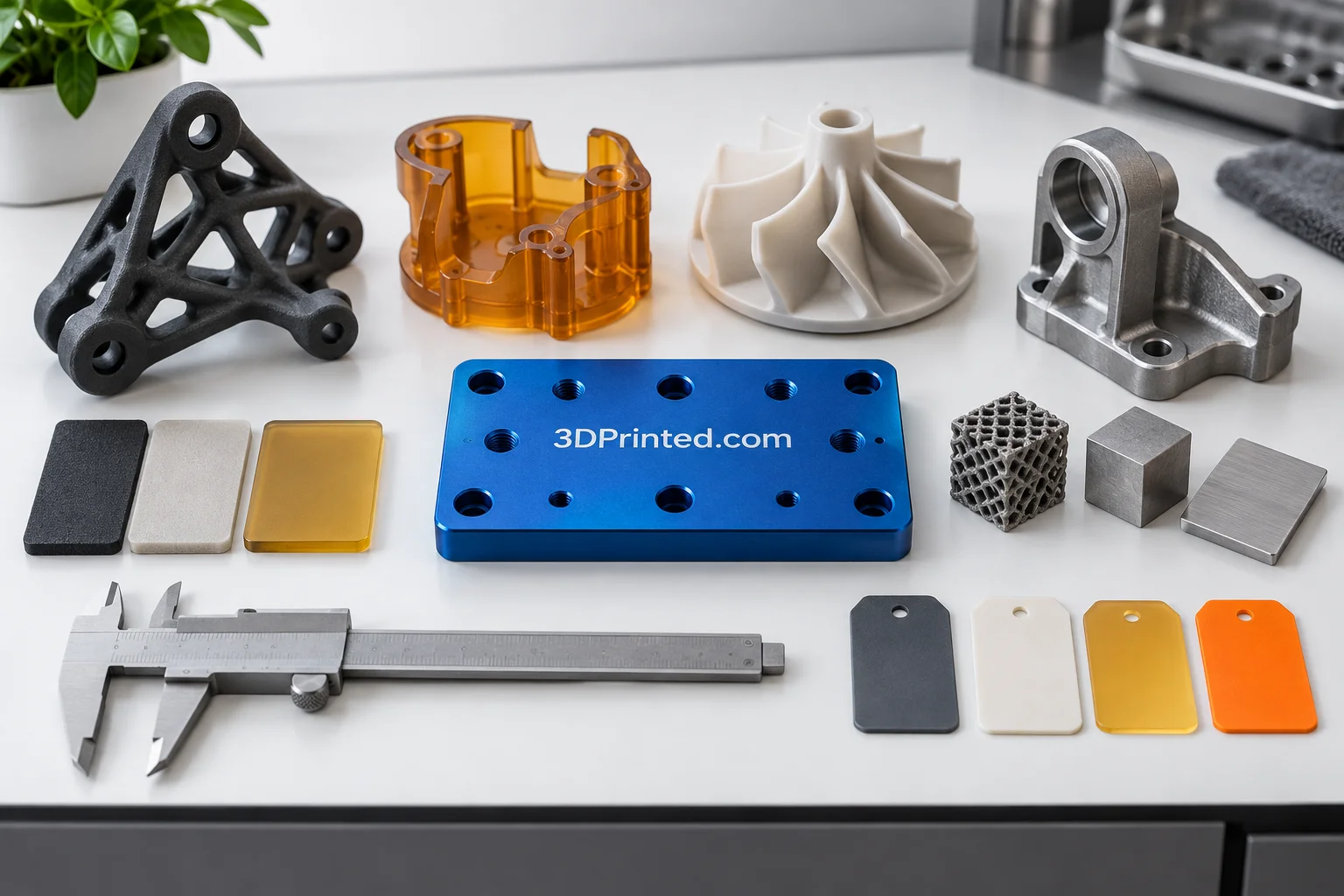
A product team looking for a 3D-printing supplier rarely needs a longer list of company names. It needs a sensible way to describe the part, compare declared capabilities, and decide which providers deserve a real engineering conversation. 3DPrinted.com could become the front door to that work through a structured service finder. This is an illustrative business concept for a future owner, not a live directory, certification program, or provider recommendation.
3DPrinted.com fits a provider comparison service because it names the output a part buyer is seeking, while leaving the process and supplier open. A brief for a 3D-printed fixture could sit under the same address as a comparison of the providers able to review it. That breadth suits a finder organized by specifications across several process families; a name tied to one machine or material would frame a narrower search.
Begin with the part brief
The first offer would turn an incomplete request into a usable capability brief. Before showing vendors, the intake would ask what the part is for, whether the design is still changing, what material properties matter, how large the part is, which dimensions need control, what finish is expected, and what inspection evidence the buyer needs. Quantity, delivery location, post-processing, and any assembly steps belong in the same record.
Those questions matter because additive manufacturing is not one uniform method. The public page for ISO/ASTM 52900:2021 identifies the established standard for additive-manufacturing fundamentals and vocabulary. A service finder could use standard-consistent process labels while avoiding copied definitions from the paid standard. Common terminology would help a buyer compare like with like and help a provider describe its work without being placed in a vague "3D printing" bucket.
The intake should also make uncertainty visible. A buyer might know the desired envelope and intended use but not the appropriate process or material. That is a legitimate starting point. The platform could label those fields as open questions and route the brief to providers willing to discuss feasibility. It should not quietly convert missing information into a confident recommendation.
Make every provider record attributable
A useful listing would separate provider-supplied statements from facts checked by the platform. The profile could show declared process families, supported materials, build-envelope limits, post-processing options, inspection resources, served locations, and a dated capability-contact record. Each field would carry a source and review date. If a capability comes from a provider questionnaire, it should say so. If it comes from a published technical page, the listing should link to that page.
A badge should never imply more than the review actually established. Confirming that a provider supplied a document is different from validating the document's scope, current status, or relevance to a particular part. The platform would need plain labels such as "provider supplied," "public page checked," and "date pending refresh." Certifications, where listed, would need the issuing body, scope, identifier, and date supplied rather than a decorative logo standing in for due diligence.
NIST's measurement science program for additive manufacturing identifies accuracy, surface quality, material consistency, monitoring, inspection, and qualification among the field's substantive concerns. A finder should use that research as a reminder to ask evidence questions, not as a basis for claiming that a provider or part has been qualified.
Compare evidence, not marketing adjectives
Search results could be organized in three layers. The first layer contains hard constraints the buyer supplied, such as build envelope, region, or a required post-processing step. The second contains provider-declared capability matches. The third lists open questions that need direct review. This structure is more honest than a single percentage score whose weighting is invisible.
A side-by-side comparison might show that two providers declare the same process family while only one lists the requested inspection method. It might also show that neither has answered a question about a particular finish. The absence of a field is useful information, but it is not proof that the provider lacks the capability. The next action should be a question, not an automatic rejection.
Any ordering rule should be published in ordinary language. If location appears first, say so. If recently refreshed records rank above stale ones, state the refresh window. Paid placement, if a future operator ever introduces it, would need a clear label and should not alter whether a provider appears to meet a technical filter. The initial pilot could avoid paid placement entirely and learn whether buyers value the comparison record itself.
Walk through a lower-risk request
Consider a hypothetical product team that needs a reusable assembly fixture for a bench operation. The fixture must locate two housings during fastening, fit within a stated work area, tolerate routine handling, and allow a technician to see the fastening points. The scenario is illustrative and does not describe a real customer or prove that additive manufacturing is the right production method.
The intake records a dimensioned file, the surfaces that locate the housings, the expected working environment, a target quantity, and the dimensions the team plans to inspect. It also records that the design may change after the first shop trial. Instead of declaring a winning process, the finder returns a short list of providers whose records address the stated envelope, candidate materials, finishing needs, and inspection request.
Each result includes questions. Can the provider review the locating surfaces before quoting? Which file format and drawing information are needed? Is the stated inspection performed internally or through another company? What post-processing could change the relevant dimensions? The buyer leaves with three comparable conversations rather than a black-box answer. The provider gets a clearer request and can decline work that falls outside its actual scope.
Build correction into the product
Capability records age quickly enough that maintenance has to be part of the offer. Providers need a simple way to claim a profile, submit updates, and challenge an inaccurate field. Buyers need a visible report-correction route. The operator needs an audit trail that preserves what changed, who supplied the change, and when it was reviewed.
A practical refresh policy could assign shorter review intervals to fields that often change and longer intervals to stable business details. The exact timing should be tested, not guessed. Expired fields would remain visible only with a clear stale label or move back to an unconfirmed state. Removing old dates would make the listing look cleaner while making it less useful.
The America Makes Additive Manufacturing Adoption Playbook connects process and material selection with design, business case, workforce readiness, and qualification. A service finder would not reproduce its worksheets, but it could reflect that broader lesson: matching a machine label is only one piece of an adoption decision.
Find the first users through a concrete tool
A credible distribution path starts with a downloadable part-brief template. Product-development consultants, design engineers, and small manufacturing teams could use it even before the directory has broad coverage. Workshops built around completing one brief would reveal which questions cause confusion and which comparison fields matter in an actual sourcing call.
On the supply side, the operator could recruit a small group of providers in one region and one or two process families. The invitation would be specific: complete the structured profile, identify the public or submitted source for each capability, and respond to correction requests. A dozen carefully maintained profiles would teach more than hundreds of scraped listings with no accountable owner.
The pilot should focus on prototypes, jigs, or fixtures where the buyer can still perform its own suitability review and where the platform can avoid presenting regulated or safety-critical guidance. Useful pilot measures include intake completion, unanswered capability fields, profile corrections, qualified introductions, and whether buyers can explain why each provider reached the shortlist. Those measures evaluate the finder workflow, not the performance of printed parts.
Operate as a record keeper, not a substitute engineer
The business would need taxonomy stewardship, provider onboarding, evidence review, date-based refreshes, buyer support, and a published approach to conflicts and corrections. It would also need clear terms explaining that listings do not establish suitability, compliance, capacity, pricing, or availability. The buyer and provider still own the engineering, commercial, and quality decisions relevant to the job.
That boundary is part of the product. A careful service finder can help people ask better questions and preserve comparable answers without pretending to certify the outcome. It can make the handoff to an engineer, procurement lead, quality specialist, or provider more efficient because the unresolved issues are already on the page.
A future owner could test this idea with one lower-risk part family, a small provider cohort, and a transparent comparison method. To discuss acquiring 3DPrinted.com for that direction, use the inquiry form and describe the intended buyers, initial coverage, and who would maintain the capability records. A partnership proposal should also explain the operating team, provider relationships, and verification process it would bring.